
Table of Contents
Comprehensive Assessment of Photochromic and Thermochromic Pigments: Underlying Mechanisms, Longevity, and Commercial Implementation
The contemporary materials engineering and fine chemical sectors increasingly rely on intelligent color-shifting substances capable of translating subtle environmental fluctuations into immediate visual data. While historically confined to aesthetic enhancements or decorative applications, these responsive materials now serve as pivotal technologies spanning safety surveillance, brand authentication, and dynamic consumer engagement. Within this expanding market, photochromic and thermochromic pigments stand out as the two most prominent solutions commanding industry attention.
Although both substances share the apparent trait of altering their hues upon exposure to external stimuli, the physicochemical processes driving their energy absorption and molecular reorganization differ profoundly. This fundamental distinction dictates their specific activation requirements, susceptibility to fatigue, physical constraints, and optimal commercial deployment. Misjudging the appropriate material for a given application can precipitate severe quality control failures, leading to rapid functional degradation or complete pigment destruction during manufacturing.
Relying on empirical data, this analysis scrutinizes the chemical foundations, material limitations, processing caveats, and sector-specific uses of both pigment types. By examining practical deployments ranging from cosmetics to aerospace engineering, this document establishes clear parameters to assist professionals in selecting the optimal reactive materials during the project planning phase.
1. Core Distinctions in Stimulus Response and Chemical Pathways
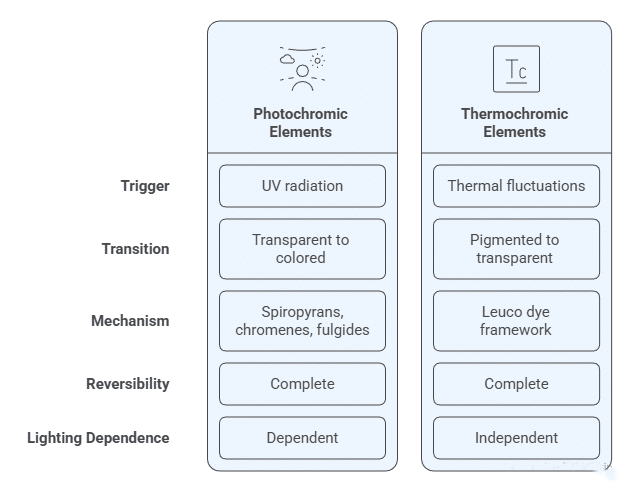
Understanding the distinct triggers and transition directions characteristic of each pigment type remains the foundational step in appropriate material selection.
① Operational mechanics of photochromic elements:
These materials depend on exposure to ultraviolet-A radiation within the 320 to 400 nanometer spectrum, black light, or specific visible light energies. Generally maintaining a transparent, colorless profile under standard conditions, they transition to a colored state within seconds to a minute of UV exposure, characterizing a transparent-to-pigmented transition.
Chemically, the primary compounds driving this reaction include spiropyrans, chromenes, and fulgides. In their unexcited state, the molecular rings remain closed, allowing light transmission and resulting in a transparent appearance. Upon UV irradiation, the chemical bonds fracture, allowing the structure to unfold into a merocyanine formation. This expanded molecular arrangement absorbs visible light, producing vivid pigmentation. Once the ultraviolet source is removed, the molecules revert to their original closed architecture, demonstrating complete reversibility back to transparency.
② Operational mechanics of thermochromic elements:
These mechanisms react exclusively to thermal fluctuations, specifically heating and cooling cycles, operating entirely independently of ambient lighting. These substances exhibit a distinct color under normal circumstances and transition toward a transparent or substantially lighter state upon reaching their designated activation temperature, representing a pigmented-to-transparent shift.
Most commercial iterations utilize a leuco dye framework, encapsulating a dye, a developer, and a temperature-sensitive solvent within a single microcapsule. Below the activation threshold, the solvent remains solid, facilitating the bond between the dye and developer to display color. As thermal energy elevates the internal temperature to the critical point, the solvent liquefies, dissociating the dye from the developer and extinguishing the visual color. Subsequent cooling solidifies the solvent once more, enabling the components to reconnect and restore the initial hue.
2. Material Properties, Durability Metrics, and Operational Vulnerabilities
Both pigment categories exhibit definitive structural limitations when exposed to specific environmental conditions. Failing to account for these constraints inevitably results in defective manufacturing outcomes.
Operational limits and precautions for photochromic substances:
| Categories | Details |
| Lifespan | Approximately 400,000 lux-hours |
| Storage duration | Roughly 12 months, strictly requiring a cool, unlit environment |
| Thermal tolerance | Can withstand up to 230 degrees Celsius, but limited to a maximum exposure of 10 minutes |
| Primary vulnerability | UV fatigue. Prolonged exposure to ultraviolet radiation induces photodegradation, permanently eradicating the color-shifting capability |
| Chemical resilience | Demonstrates moderate stability against pH fluctuations but remains highly susceptible to oxidants and ozone |
Constraints and handling protocols for thermochromic materials:
| Categories | Details |
| Photostability | Exceptionally poor, rating between 1 and 2. Outdoor ultraviolet exposure risks complete and irreversible loss of the color-changing property |
| Thermal tolerance | Recommended processing at 200 degrees Celsius, with an absolute threshold of 230 degrees Celsius |
| Chemical incompatibilities | Fails in alkaline environments exceeding pH 8, and reacts adversely with ammonia, ethanol, and ketone-based solvents |
| Agitation requirements | Gentle, low-speed mixing is mandatory. High-shear dispersion forces will rupture the protective microcapsules |
| Prohibited formulations | The integration of opaque fillers, such as titanium dioxide or carbon black, will severely diminish the intensity of the color transition |
| Exterior applications: | Unviable without the mandatory application of heavy UV-protective coatings |
3. Sector-Specific Implementations and Synergies
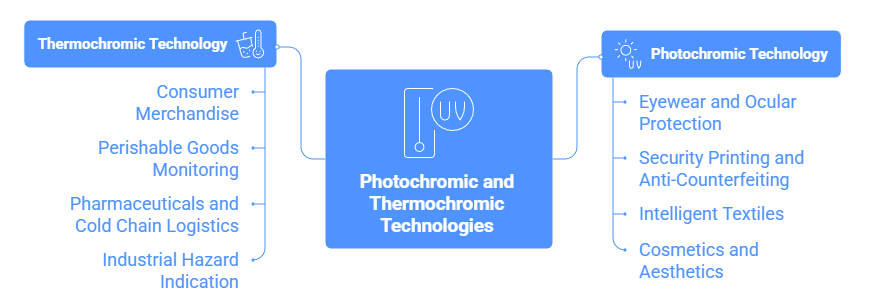
Each substance is integrated across diverse industries utilizing methodologies tailored to their specific responsive traits.
Key commercial pathways for photochromic technology:
- Eyewear and ocular protection: Lenses darken when subjected to exterior solar radiation to shield the eyes, subsequently regaining transparency indoors.
- Security printing and anti-counterfeiting: Utilized as covert inks that materialize solely under ultraviolet inspection, validating product authenticity.
- Intelligent textiles: Incorporated into apparel and athletic gear to provide wearers with real-time visual alerts regarding excessive ultraviolet radiation exposure.
- Cosmetics and aesthetics: Applied in nail polishes and beauty formulations that transform shades under sunlight, elevating the interactive consumer experience.
Prominent utilization of thermochromic technology:
- Consumer merchandise: Applied to ceramics like mugs that reveal concealed graphics when filled with hot beverages reacting between 31 and 47 degrees Celsius, or integrated into jewelry and garments that respond to human body heat between 30 and 37 degrees Celsius.
- Perishable goods monitoring: Responsive labels calibrated to the 4 to 25 degrees’ Celsius range visually confirm optimal consumption temperatures and mitigate spoilage risks.
- Pharmaceuticals and cold chain logistics: Deployed in ultra-low temperature freight monitoring for vaccines, where thermal breaches trigger an irreversible color shift, instantly identifying logistical failures.
- Industrial hazard indication: Warning decals calibrated to 60 degrees Celsius are affixed to engines and electrical enclosures to preemptively signal mechanical overheating and avert potential fires.
4. Economic Analysis and Commercial Availability
The two responsive materials diverge significantly regarding manufacturing expenses and procurement options.
Assessing photochromic variables:
Supply diversity remains somewhat constrained, heavily skewed toward ultraviolet-reactive options. The spectrum of achievable colors is notoriously challenging, often struggling to yield highly saturated or vibrant tones. Available supply formats are generally restricted. Cost competitiveness is low, as premium quality commands steep prices, creating substantial barriers to entry. Consequently, accessibility for small and medium-sized manufacturers is hindered by considerable technical and financial obstacles.
Assessing thermochromic variables:
Supply diversity is robust, offering customizable temperature thresholds ranging from negative 10 to 69 degrees Celsius. The color reproduction capacity is versatile, easily achieving reds, blues, yellows, and blacks. Materials are supplied in multiple accessible formats, including aqueous slurries, free-flowing powders, and masterbatches. Price competitiveness remains high due to economies of scale and straightforward mass production. Therefore, procurement and implementation by smaller manufacturing entities are comparatively seamless.
5. Strategic Selection Criteria for Successful Implementation
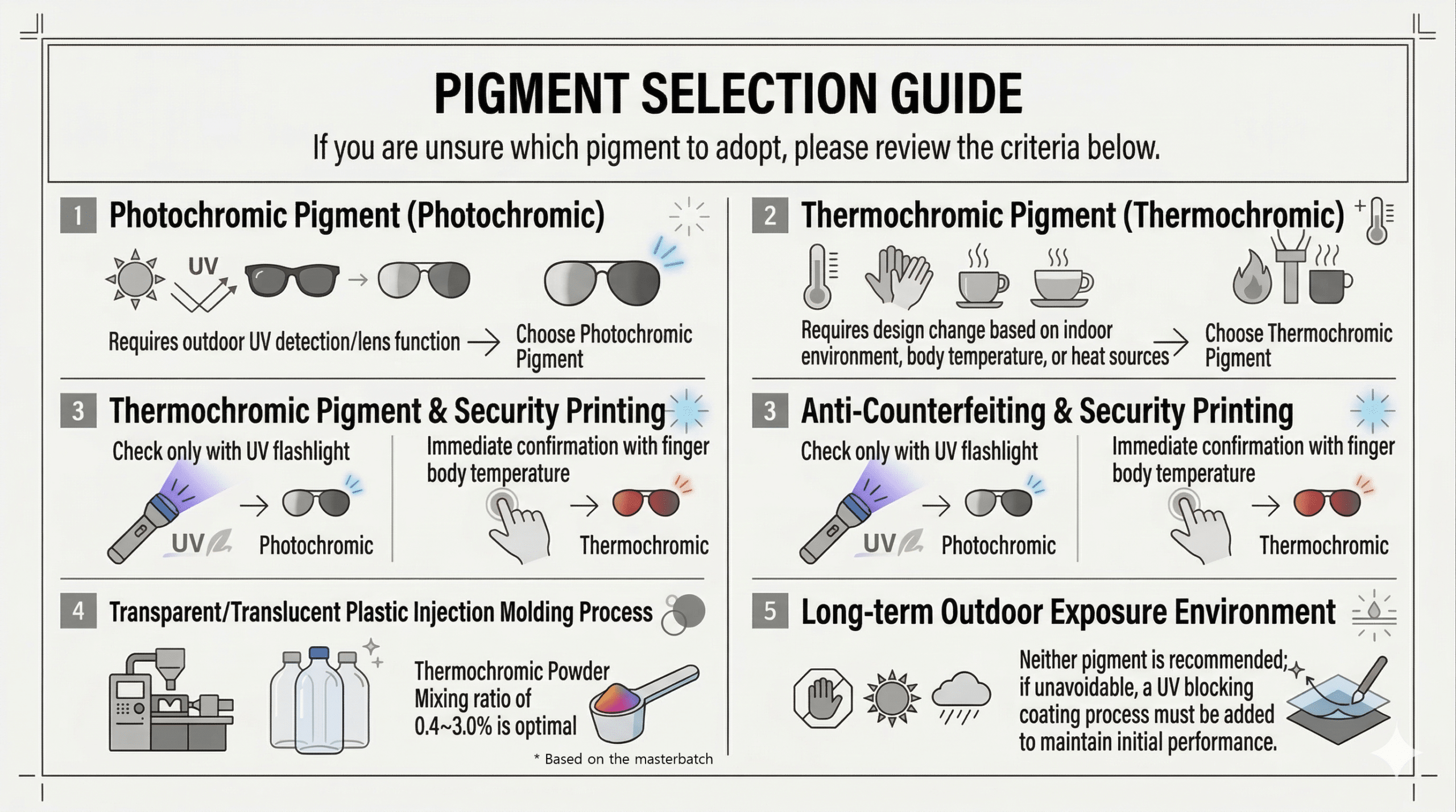
Professionals deliberating between these two reactive materials should evaluate the following foundational criteria:
First, if the objective involves detecting outdoor ultraviolet rays or requires lens adaptation functionalities, opt for photochromic pigments.
Second, if the design demands visual shifts triggered by indoor conditions, human touch, or mechanical heat sources, thermochromic variants are the appropriate choice.
Third, for authentication and secure printing purposes, select photochromic inks if verification relies on a UV flashlight, but utilize thermochromic inks if instant validation via fingertip body heat is preferred.
Fourth, when executing translucent or transparent plastic injection molding, blending thermochromic powder at a ratio of 0.4 to 3.0 percent yields optimal results.
Fifth, neither material is inherently suitable for prolonged outdoor exposure. If such environments are unavoidable, integrating a robust UV-blocking overcoat is an absolute necessity to preserve the initial responsive characteristics.
Conclusion
(Video 1: Operational mechanics of photochromic and thermochromic pigments alongside optimal industry application guidelines)
Both photochromic and thermochromic materials represent sophisticated functional engineering, designed to translate invisible energy fluctuations into immediate, intuitive visual metrics. By absorbing ultraviolet radiation to pry open molecular rings and generate vivid colors, photochromic compounds drive advancements in solar warning systems and adaptive optics. Conversely, thermochromic substances regulate pigmentation via internal phase shifts within microcapsules, serving as versatile safety indicators ranging from tactile fever detection to industrial heat warnings and stringent cold-chain surveillance.
Achieving commercial viability requires a rigorous understanding of the processing limitations and durability thresholds intrinsic to each material. Variables such as rapid degradation from continuous solar exposure, the physical rupturing or chemical dissolving of microcapsules, and strict solvent compatibility requirements must be meticulously managed from the initial design phase to prevent catastrophic product failures. By mastering the physicochemical constraints of these materials and adhering to established implementation protocols, developers can engineer highly reliable, innovative products that meaningfully enhance consumer safety and elevate everyday experiences.
Frequently Asked Questions (Q&A)
Q1. What constitutes the primary difference between photochromic and thermochromic materials?
Photochromic substances generate color in response to light exposure, such as ultraviolet or visible spectrums. In contrast, thermochromic materials operate by fading or entirely losing their initial color in response to specific temperature changes.
Q2. Are both pigment types viable for prolonged outdoor deployment?
Continuous outdoor exposure is not advised for either category, as persistent ultraviolet radiation induces photodegradation and rapidly depletes their functional lifespan. If exterior use is mandatory, applying heavy UV-protective varnishes is critical.
Q3. Do photochromic elements react to standard indoor lighting?
While their primary trigger is concentrated outdoor ultraviolet or black light, certain indoor illumination setups may provoke a slight, premature activation depending on the specific light emissions.
Q4. Are there equipment constraints when blending thermochromic compounds?
Aggressive processing machinery, including ball mills and high-shear agitators, will fracture the delicate microcapsules. Consequently, integration must rely exclusively on gentle, low-speed mixing techniques.
Q5. Is photochromic technology generally more expensive than thermochromic alternatives?
Yes. Producing high-grade photochromic pigments that yield intense, stable coloration involves substantial manufacturing complexities, resulting in higher unit costs and a narrower range of available suppliers compared to thermal-reactive options.
Are you evaluating the integration of intelligent color-shifting materials to elevate your product’s market differentiation and consumer safety protocols?
If you require a bespoke photochromic or thermochromic solution tailored to your exact manufacturing parameters and project environments, consult with our specialists today to initiate a successful development process.