
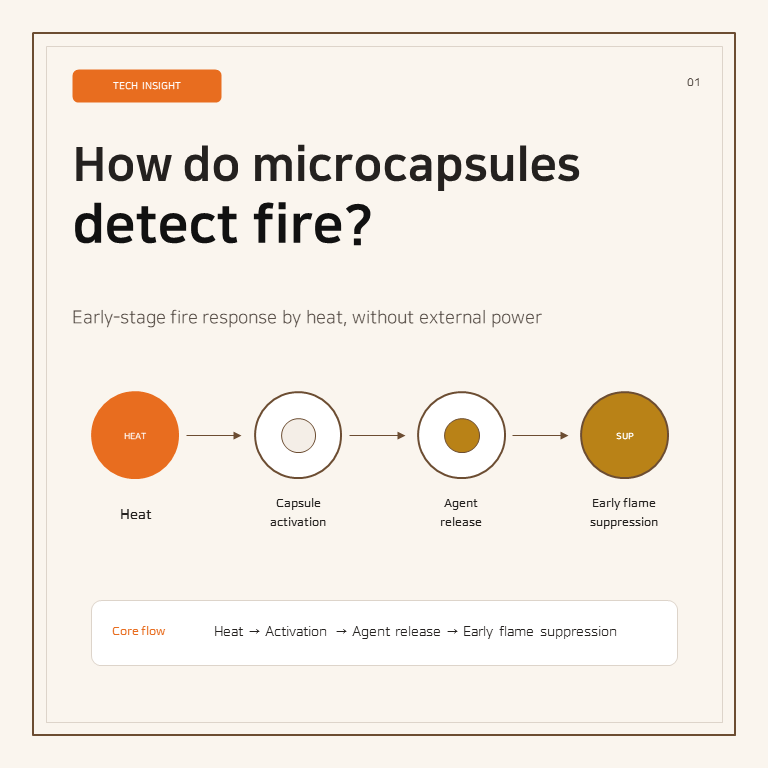
Fire Extinguishing Microcapsules release an agent in response to heat. Performance depends on activation conditions, protected volume, placement, and ventilation.
Table of Contents
How Do Fire Extinguishing Microcapsules Respond to an Early-Stage Fire in a Confined Space?
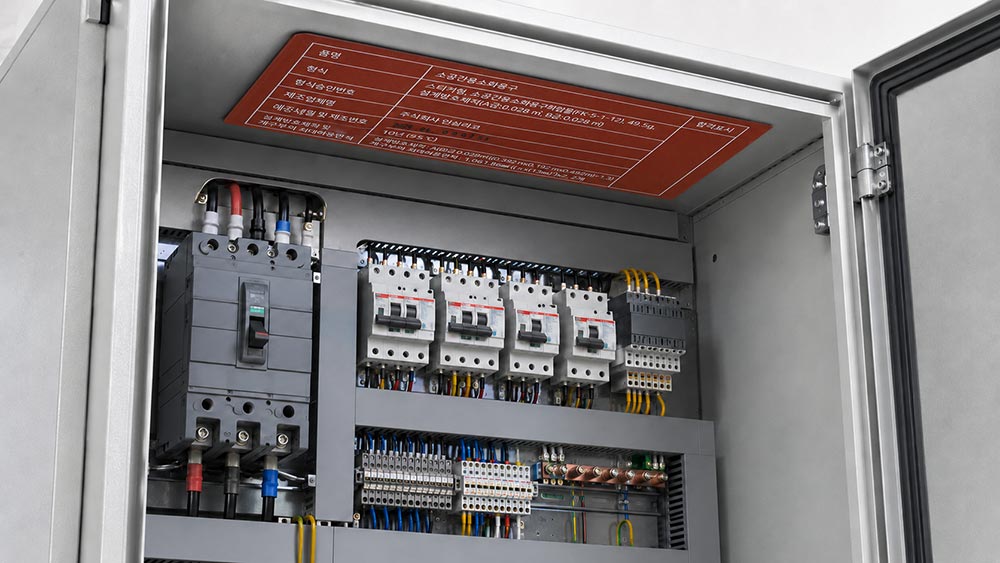
Electrical equipment such as panel boards, switchboards, and control cabinets can catch fire because of overheated connections, damaged insulation, short circuits, or aging components. Since the inside of an enclosure is difficult to observe during normal operation, flames and smoke may not be externally visible at the beginning of a fire. By the time someone notices the problem, the fire may have already spread to nearby wiring and components.
Fire Extinguishing Microcapsules are functional materials designed to suppress incipient fires in confined spaces. Each microscopic shell encapsulates a fire-extinguishing agent and ruptures at a predetermined temperature, releasing the agent directly in response to heat. This thermally activated mechanism enables autonomous operation without an external power supply or separate detection signal.
However, the rupture of the microcapsules does not guarantee that a fire will be extinguished automatically under all conditions. Agent quantity, protected volume, fire size, installation position, and ventilation configuration can all affect performance. The boiling point of the agent must also be distinguished from the capsule activation temperature.
Insilico is initially focusing this technology on limited-volume spaces such as panelboards and electrical cabinets. In these enclosed spaces, the microcapsules can be installed close to potential ignition sources. When a fire raises the temperature to the activation threshold, the capsules rupture and immediately release FK-5-1-12. As the agent vaporizes, it rapidly absorbs heat around the ignition source, helping suppress the fire at an early stage. The following sections explain the structure and operating mechanism of Fire Extinguishing Microcapsules, how temperature information should be interpreted, and what conditions must be assessed before application.
1. Structure of Fire Extinguishing Microcapsules

Roles of the core agent and capsule shell
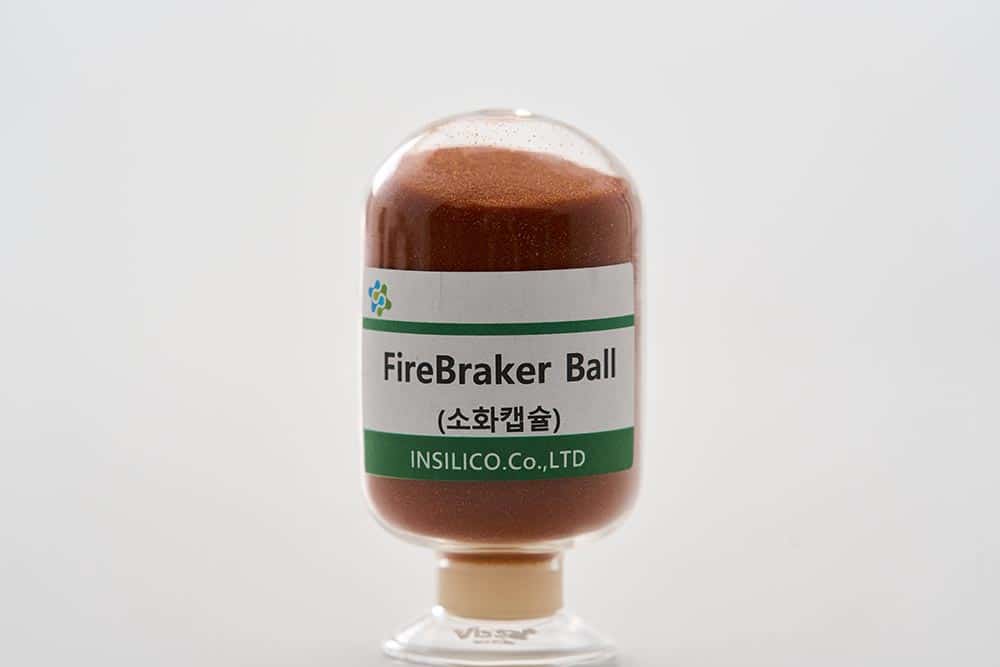
Fire Extinguishing Microcapsules consist of an internal extinguishing agent surrounded by a shell. The agent is responsible for suppressing combustion, while the shell prevents the agent from escaping under normal storage and operating conditions. This structure allows a liquid or volatile material to be retained as fine particles and released when needed.
The shell must retain the agent during normal use while opening at an appropriate point during a fire. If the response threshold is too low, heat from ordinary equipment operation may cause unintended release. If the shell responds only at an excessively high temperature, activation may not occur until the fire has grown.
Response conditions are not determined by shell material alone
A capsule’s thermal response can be affected by shell material and thickness, capsule size, internal pressure, heating rate, and exposure duration. Reaching the same peak temperature does not necessarily produce the same result under rapid, short-term heating and prolonged exposure to a lower temperature.
For this reason, a capsule activation temperature cannot be adequately described by one number alone. The test method and response criteria defined in the applicable product specification must also be reviewed when determining formal operating conditions.
Difference between raw capsules and finished products
Microcapsules are generally incorporated into finished products such as pads, sheets, stickers, or coating layers rather than used solely as loose particles. Product performance may therefore depend on the binder, substrate, adhesive layer, product dimensions, agent quantity, thickness, and installation position, as well as the capsules themselves.
The fact that a particular capsule releases its agent in response to heat does not establish that every product containing that capsule will perform identically. The properties of the microcapsule material and the fire-extinguishing performance of the finished fire suppression capsule product must be evaluated separately.
2. How Heat Triggers Agent Release?
Passive activation by heat
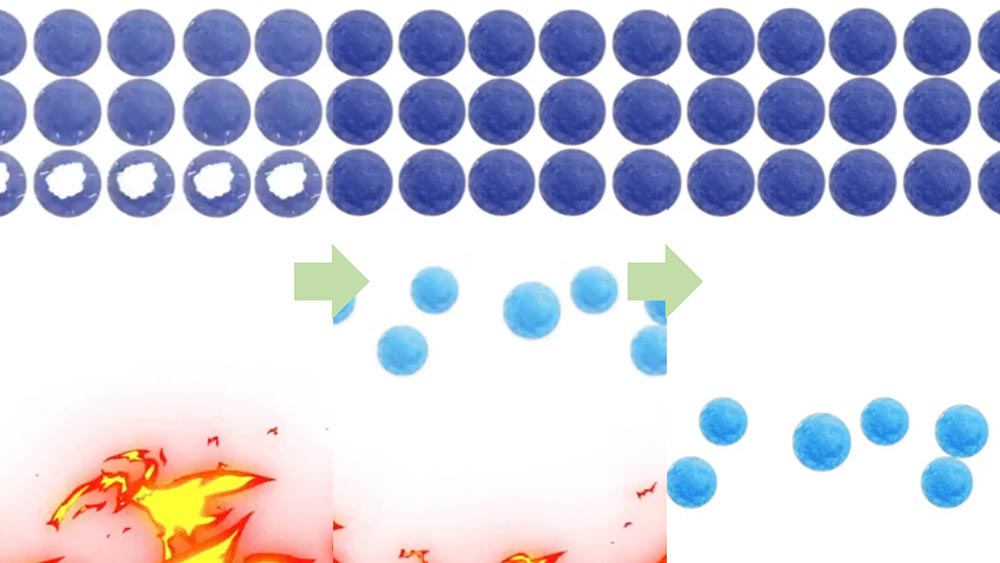
A thermally activated capsule keeps its internal agent enclosed during normal conditions. When a fire occurs, flames and hot combustion gases raise the surrounding temperature. Heat then travels to the installed product. Once the product reaches its response conditions, the shell may soften or expand until cracking or rupture allows the internal agent to escape.
This process can begin directly in response to heat without an external power supply, sensor signal, or control command. Heat itself remains the initiating factor even if electrical power is interrupted or separate detection equipment does not operate. This is the defining feature of a passive fire suppression device based on microcapsules.
Heat movement inside a cabinet
The entire interior of a cabinet does not reach the same temperature simultaneously. Heat generally rises, but fans, vents, components, wiring, and internal partitions can alter its path.
If a Fire suppression capsule is positioned too far from the expected ignition source, or if an intervening structure blocks heat transfer, activation may be delayed. Conversely, installation next to a component that remains hot during normal operation may expose the product to elevated temperatures over an extended period.
Criteria for selecting the installation position
An appropriate installation position must allow fire-generated heat to reach the product and the released agent to travel toward the ignition point. Attaching a passive fire suppression device to any available surface inside the cabinet should not automatically be considered sufficient.
Stability must also be assessed under non-fire conditions, including maximum-load operation, high summer ambient temperatures, and ventilation-fan shutdown. Product-specific specifications and installation instructions should determine the required orientation, separation distance, and allowable operating temperature.
3. How the Released Agent Suppresses Fire?
Heat absorption in the high-temperature zone
Insilico’s published materials identify an FK-5-1-12-based extinguishing agent. After release, the agent can absorb heat as it vaporizes or disperses in a high-temperature area. This heat absorption can help lower the temperature around a flame and make continued combustion more difficult.
Combustion requires the continued presence of fuel, oxygen, heat, and conditions that sustain the chain reaction. When the agent absorbs sufficient heat, the energy available to maintain combustion decreases. An early flame may consequently weaken, or further fire spread may be suppressed.
Effective concentration matters more than release alone
Agent release does not by itself guarantee extinguishment. A sufficient quantity must reach the fire area and remain at an effective concentration for an adequate period. If the amount is too low for the protected volume, or if the fire has already grown substantially, the event may exceed the intended scope of an early-stage fire suppression capsule.
The total weight of a finished product is therefore not enough to assess its suitability. The actual agent quantity, rated protected volume, relevant fire class, and applicable test conditions must be considered together.
Effects of openings and ventilation
If a door is open or the enclosure has large cable entries or ventilation openings, the released agent may escape. Continued operation of a forced-ventilation fan may further reduce the agent’s retention time.
Partitions and internal components may also prevent the agent from reaching the ignition source. Where one enclosure contains multiple compartments, the assessment should be based on the effective volume through which heat and agent can move—not solely on the enclosure’s external dimensions.
4. Agent Boiling Point vs. Capsule Activation Temperature
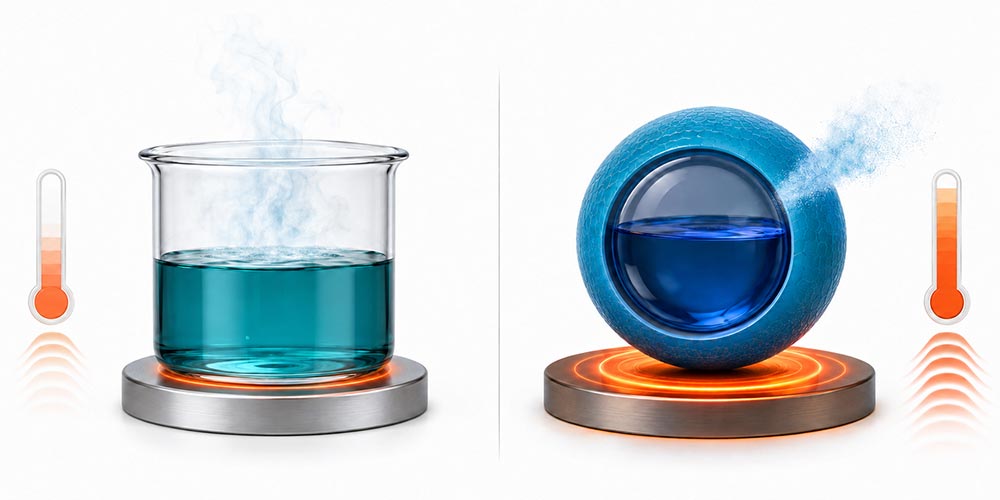
Two different temperature concepts
The boiling point of an extinguishing agent and the capsule activation temperature describe different events. A boiling point is the temperature at which a liquid changes into a gas at a specified pressure. Activation refers to the conditions under which the capsule shell changes structurally and begins releasing the internal agent.
Published FK-5-1-12 property data lists a boiling point of approximately 49°C to 49.2°C at one atmosphere, depending on the referenced data sheet. This does not mean that Fire Extinguishing Microcapsules rupture as soon as they reach 49.2°C. The agent remains contained while the shell maintains its integrity.
Limits of interpreting a single value
Actual release conditions can vary with shell composition and thickness, capsule design, internal pressure, heating rate, and exposure time. Some capsules may respond first, followed by an increase in total release as the temperature continues to rise.
Even when a patent or research paper reports a specific activation temperature, that value applies to the composition and test conditions used in that work. Applying it to a commercial product with a different composition or manufacturing process requires product-specific test data.
5. Stability Testing and Actual Operating Conditions
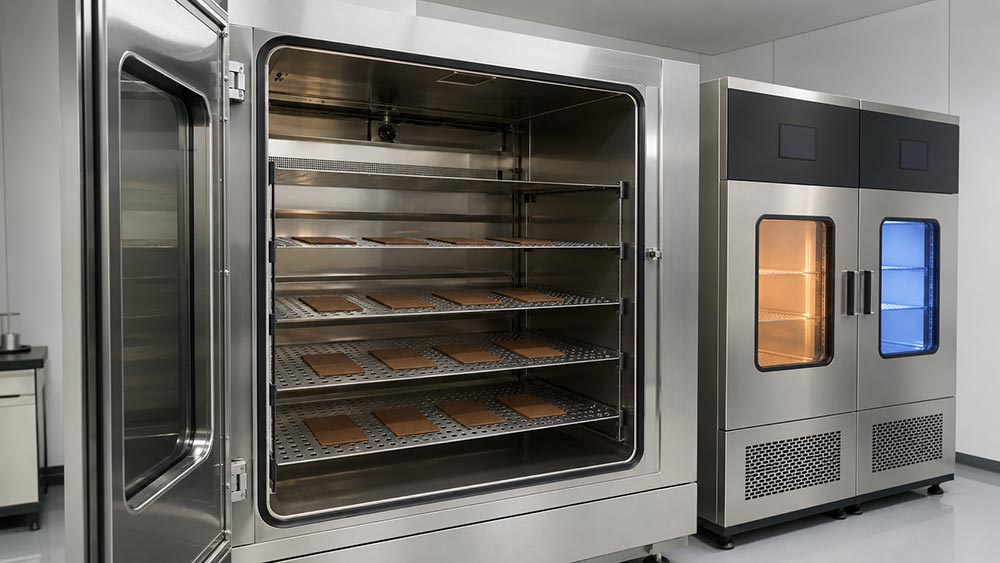
A stability temperature is not an activation temperature
Insilico states that the capsule shell protects its internal agent below 100°C. Its published test conditions also include storage for 24 hours at 80°C and 80% relative humidity, as well as 300 thermal-shock cycles alternating between a high-temperature bath at 82°C for six minutes and a low-temperature bath at 20°C for eight minutes.
These conditions should be interpreted as defined stability and thermal-durability tests. They do not establish that 100°C is the exact capsule activation temperature. Likewise, stability after 24 hours at 80°C does not prove that the same condition can be maintained indefinitely in every operating environment.
Long-term changes must be considered in the field
Repeated temperature changes, vibration, dust, humidity, contamination, changes to the adhesive surface, and physical impacts during maintenance may affect a product installed inside electrical equipment. Surviving one high-temperature test is not equivalent to withstanding years of repeated thermal cycling.
Release behavior may also change if the product detaches, tears, becomes compressed, or sustains damage to the capsule layer. A passive fire suppression device still requires periodic checks for adhesion, deformation, damage, contamination, and leakage. The manufacturer’s specified service period and replacement criteria should also be followed.
6. Conditions to Check for Confined-Space Applications
Verify the effective internal volume
Because a microcapsule product can contain only a limited quantity of extinguishing agent, panelboards, switchboards, electrical control enclosures, and communication or instrumentation cabinets are reasonable initial application targets.
Before installation, the effective space through which the agent can travel should be calculated rather than relying only on external enclosure dimensions. If the enclosure is divided into compartments, each compartment should be checked to determine whether heat and agent can move between them.
Interpret the design protection volume correctly
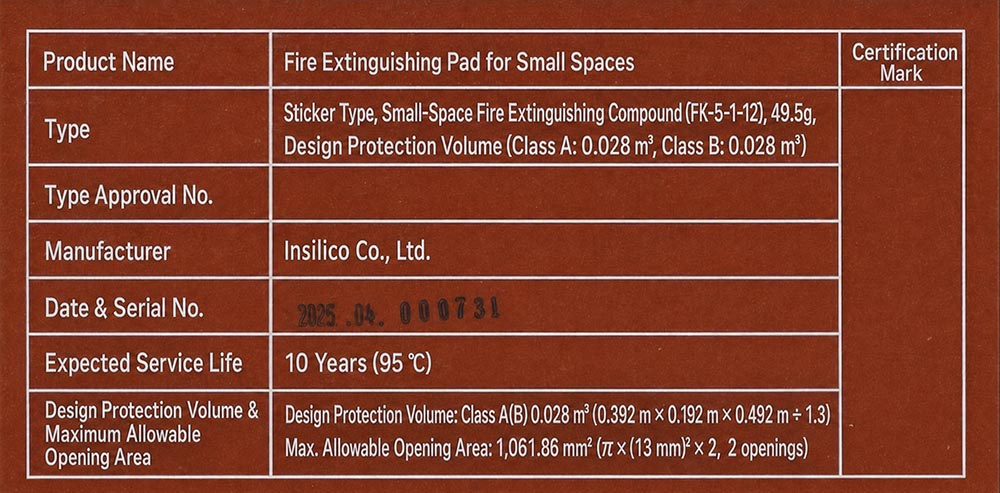
According to Insilico’s published specification, its fire-extinguishing pad for confined spaces measures 200 × 100 × 3 mm and has a total weight of 49.5 g. The stated design protection volume is 0.028 m³ for both Class A and Class B fires.
Although 0.028 m³ equals 28 liters, this value does not guarantee identical performance in every enclosure of 28 liters or less. It must be interpreted in relation to the approved product configuration, installation method, and test conditions. Openings, fans, obstructions, and the type of fire source may change actual performance.
Insilico reports that the fire-extinguishing pad received Korea Fire Institute type approval on September 10, 2025. The approval applies to the specified finished product and its approved configuration; it should not be treated as blanket approval for every application of the underlying microcapsules.
Multiple installations and product modifications
The protected volume should not be assumed to increase in exact proportion to the number of pads installed. Whether multiple units may be used—and where each unit should be positioned—must be confirmed through the approval specifications and the manufacturer’s technical documentation.
Cutting the finished product, combining it with another adhesive, or otherwise modifying its structure may alter the agent quantity and release characteristics. There is insufficient basis to extend a test result or type approval for one finished product to a modified product or another application format.
Conclusion
(Video 1: Operating principle, activation conditions, and confined-space application requirements for Fire Extinguishing Microcapsules)
Fire Extinguishing Microcapsules are functional materials designed to retain an extinguishing agent inside a fine shell and release it in response to fire-generated heat. Because activation can occur without an external power supply, they may be considered for early-stage fire response in difficult-to-monitor spaces such as panel boards and electrical cabinets.
Performance is not determined by the capsule activation temperature alone. Heat-transfer rate, distance from the ignition source, agent quantity, effective protected volume, openings, ventilation, and internal cabinet geometry all influence the result. The agent’s boiling point, the capsule’s activation conditions, and stability-test temperatures must be interpreted separately.
Raw microcapsules and finished fire-extinguishing pads are also not equivalent. A finished product’s performance and approval depend on its defined structure, dimensions, agent quantity, and installation conditions. Those results cannot automatically be extended to other product formats.
Before adopting Fire Extinguishing Microcapsules, users should determine the effective protected volume, maximum normal operating temperature, ventilation configuration, expected ignition source, and installation position. The technology should be understood as a supplementary early-stage response measure for confined spaces under defined conditions, rather than a replacement for all forms of fire protection.
Frequently Asked Questions (Q&A)
Q: What are Insilico Fire Extinguishing Microcapsules?
A: They are small capsules containing an FK-5-1-12 fire-extinguishing agent. When exposed to heat from a fire, the capsule shell opens and releases the agent to help suppress the fire at an early stage.
Q: Do they need electricity or a battery?
A: No. The capsules react directly to heat, so they do not require an electrical connection, battery, sensor signal, or control signal.
Q: At what temperature do they activate?
A: It begins to activate at around 130°C, although the exact point of activation may vary depending on the rate of temperature increase and the duration of heat exposure.
Q: Can they be used inside electrical panels and switchboards?
A: Yes. Electrical panels, switchboards, control cabinets, and communication or measuring-equipment cabinets are listed as suitable application areas. Product selection and placement should be based on the internal space, partitions, ventilation, normal operating temperature, and likely fire location.
Q: What maintenance is required?
A: Check the product during regular equipment inspections. Make sure it remains firmly attached and has no damage, contamination, deformation, or leakage. Follow the service period and replacement instructions provided by the manufacturer.
Before applying a product based on Fire Extinguishing Microcapsules to a panel board, switchboard, or electrical cabinet, confirm the internal volume, maximum normal operating temperature, ventilation structure, expected ignition source, and proposed installation position.
Insilico provides information on the type-approval conditions, certified protection volume, and installation and application guidelines for its fire-suppression pads. Because product suitability may vary depending on enclosure size and configuration, ventilation, and normal operating temperature, customers should conduct sufficient testing and validation under their specific operating conditions before adopting the product.
References
- Insilico — Fire Extinguishing Pad KFI Type Approval and Product Specifications
- Fike — FK-5-1-12 Clean Agent Data Sheet
- Journal of Materials Chemistry A — Self-triggered fire-extinguishing microcapsules with pronounced performance in suppressing the thermal runaway of lithium-ion batteries
- 3M — Novec 1230 Fire Protection Fluid Technical Data